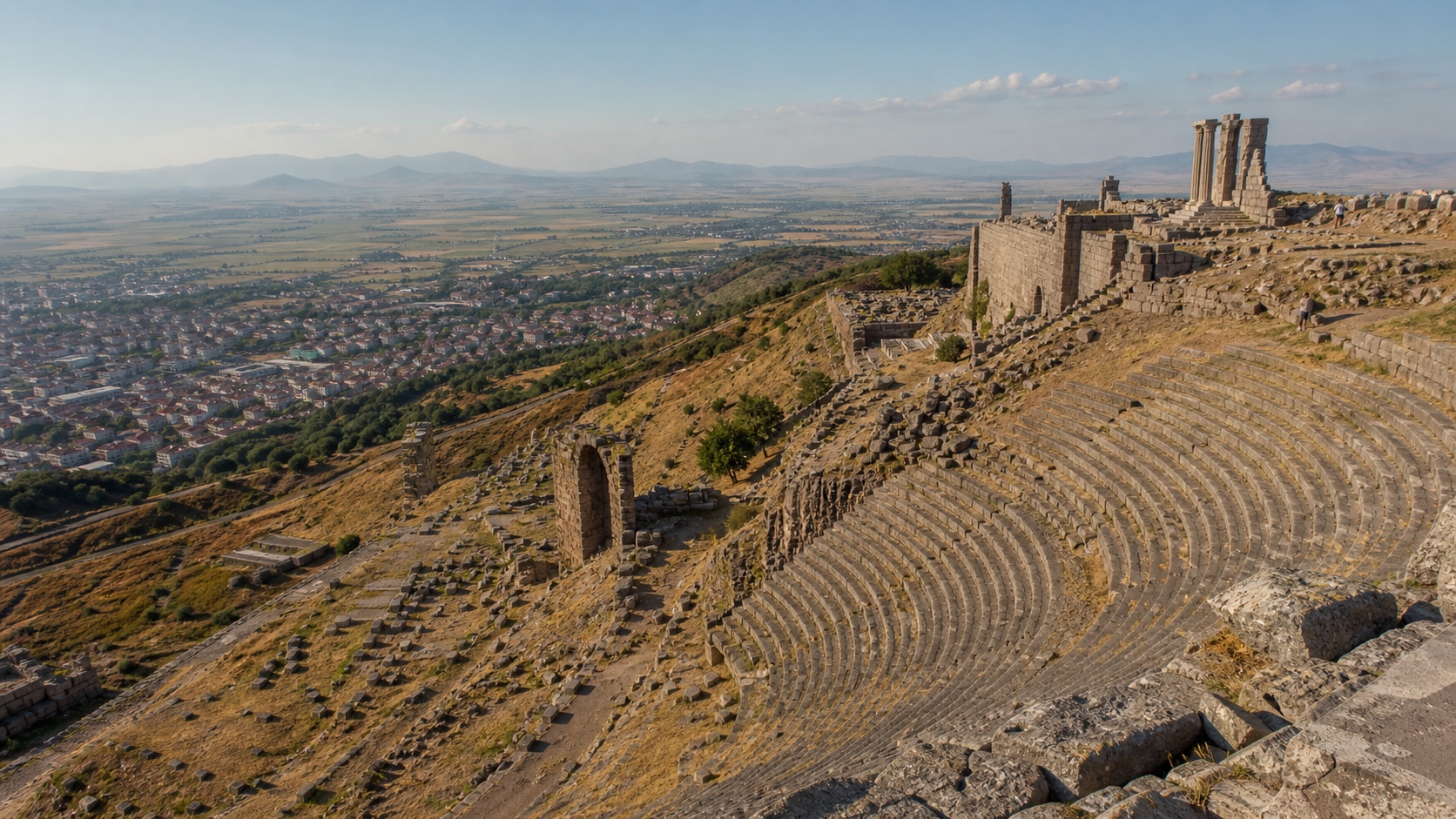
Pergamon reveals itself vertically. From modern Bergama, the ancient acropolis rises on Kale Hill like a stone crown above the Bakırçay Plain. The climb is part of the story: rulers of the Attalid dynasty used the steep terrain to create a city of terraces, controlled views and monuments that projected authority far beyond the summit.
The acropolis was the political and cultural heart of a powerful Hellenistic kingdom. It later became part of the Roman world, while settlement continued down the slopes through Byzantine and Ottoman periods. UNESCO therefore recognises Pergamon not as a single ruin but as a multi-layered cultural landscape that includes the acropolis, Asklepieion, burial mounds and historic town below.
A city designed around the hillside
Pergamon’s planners did not flatten the mountain. They worked with it. Retaining walls and artificial terraces created platforms for sanctuaries, palaces, public spaces and entertainment buildings. The result is one of antiquity’s clearest demonstrations of architecture used to organise an entire landscape.
Highlights of the acropolis
The theatre
The theatre is set dramatically into the western slope. Its narrow, steep seating gives spectators an immense view across the plain while solving the practical challenge of building on limited ground. Walk carefully and resist judging it only through photographs: the relationship between stage, terrace and horizon is what makes it exceptional.
Temple of Trajan
The white marble remains of the Trajaneum stand on a high terrace. Much of what visitors see has been carefully reassembled, making it useful to distinguish surviving ancient fabric from modern conservation work. The terrace also helps explain how Roman imperial monuments were inserted into an earlier Hellenistic royal landscape.
Library and Altar of Zeus
Pergamon was celebrated as a centre of learning, and its library became part of the city’s later reputation. The monumental Altar of Zeus is no longer intact on the hill; major sculptural elements are in Berlin. At the site, the empty foundation and surrounding terraces still communicate the altar’s position within the ceremonial city. A responsible visit acknowledges both the power of the original setting and the complicated modern history of displaced antiquities.
How long to spend
Allow roughly two hours for the acropolis if you want to move slowly, read the landscape and descend to the theatre with care. Surfaces can be steep and exposed. Wind, summer heat and winter rain all change the experience, so shoes with grip and layered clothing are sensible.
Opening hours, cable-car operation and ticket arrangements may change seasonally. Check official information shortly before your visit rather than relying on an old blog timetable.
Pairing the acropolis with Bergama
The acropolis is only one chapter. The Asklepieion, Red Basilica, Bergama Museum, Ottoman bazaar and traditional neighbourhoods show how the city continued beyond the Attalid court. A full day works well; a rushed stop at the summit does not.
For travellers coming from central İzmir, İzmirBlog can arrange transport and a guide who connects the hilltop remains with the living town below, with enough time for lunch and the museum rather than treating Pergamon as a distant photo opportunity.
Editorial sources: Primary source · Supporting source 1. Visitor information can change; verify current access arrangements before travelling.
Share a useful local note