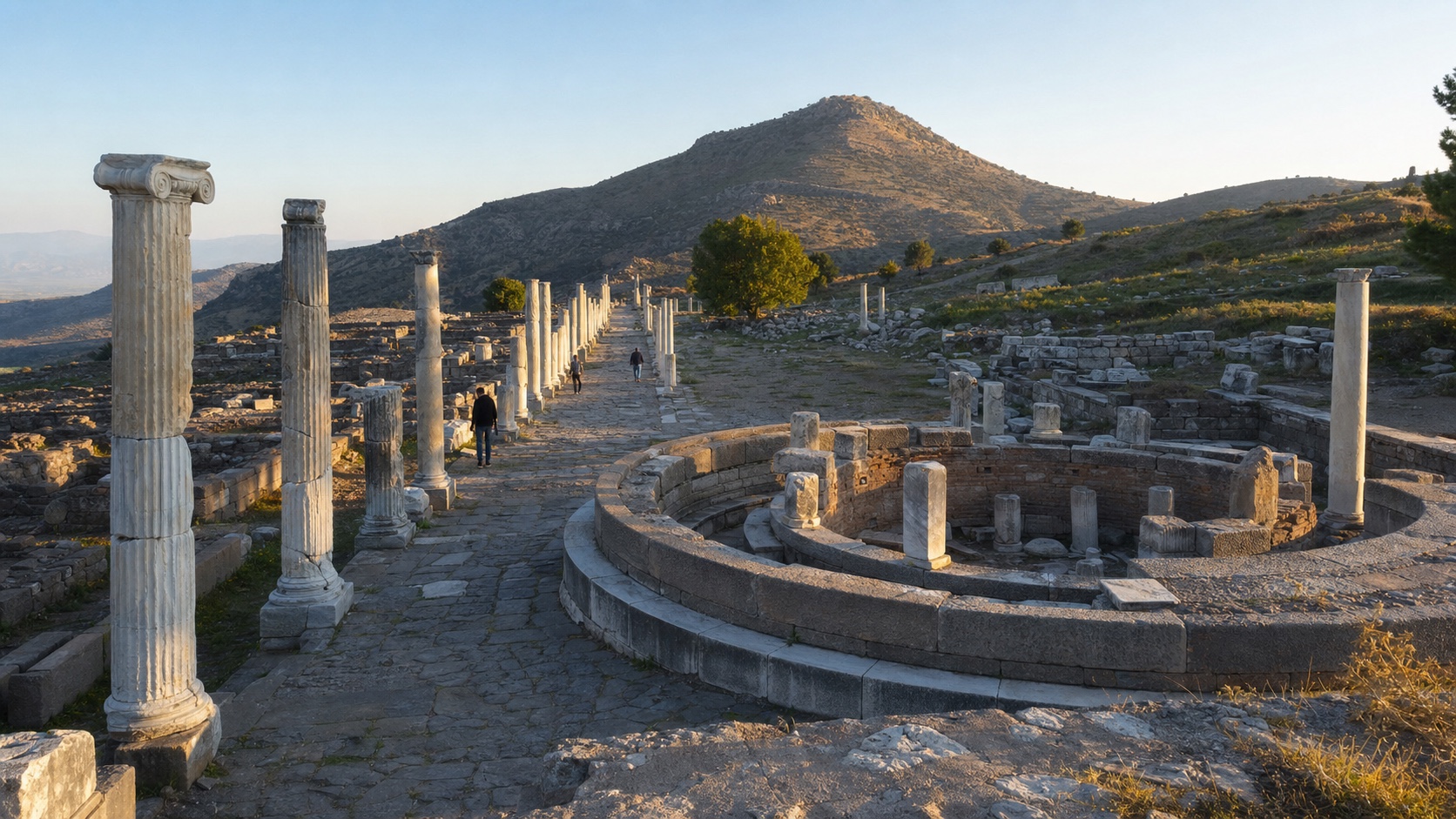
The Asklepieion of Pergamon was both sanctuary and healing centre, a place where religion, observation, environment and social ritual met. It should not be described as a hospital in the modern clinical sense. Visitors came under the protection of Asklepios, the god of healing, and followed practices rooted in the medical understanding and beliefs of their own time.
The sanctuary lies outside the acropolis and historic centre of Bergama. Its physical separation was meaningful: arrival along the Sacred Way created a transition from ordinary urban life into a controlled landscape of water, sleep, movement and worship.
Healing in the ancient world
Treatment at an Asklepieion could involve bathing, rest, diet, exercise, interpretation of dreams and participation in sacred rites. Pergamon’s spring still helps visitors understand why water became central to the identity of the complex. Claims that every illness was cured here, or that the sanctuary functioned exactly like a modern psychiatric hospital, oversimplify a much more interesting institution.
The physician Galen was born in Pergamon in the second century CE and received part of his early education in the city. His long influence on medicine gives the site an important intellectual association, although the sanctuary’s history began centuries before him.
What survives at the Asklepieion
The Sacred Way
The colonnaded approach connected the sanctuary with the city. Imagine it as a carefully staged entrance rather than merely a road: pilgrims and patients moved towards a place with its own rules, sounds and expectations.
The healing spring and treatment spaces
Water continues to flow within the archaeological area. Nearby underground passages and circular structures are often interpreted through ancient treatment practices. The surviving architecture cannot tell us every detail of an individual patient’s experience, but it does reveal how movement, shade, acoustics and water were designed into the complex.
The theatre
A compact theatre forms part of the sanctuary. Performance and communal life were not separate from wellbeing in the ancient Mediterranean. Its presence reminds us that healing was understood socially and spiritually as well as physically.
Visiting with the right expectations
The Asklepieion is quieter and easier to read than the acropolis, but it still deserves at least an hour. There is limited shade across parts of the site, and the ancient surfaces call for comfortable footwear. Check current opening and ticket information through official channels, particularly outside the main travel season.
Do not rush from one labelled ruin to another. Follow the entrance axis, listen near the water and notice how the buildings frame a sheltered world below the acropolis. The experience becomes much richer when you understand that architecture itself formed part of the sanctuary’s healing atmosphere.
Building a Bergama day
The Asklepieion pairs naturally with the acropolis and Bergama Museum, but the three sites require realistic travel time. Add the Red Basilica and old bazaar only if you have a full day. İzmirBlog can arrange a private Bergama itinerary with transport and guiding, allowing the medical, religious and urban stories to connect without turning the day into a race.
Editorial sources: Primary source · Supporting source 1. Visitor information can change; verify current access arrangements before travelling.
Share a useful local note