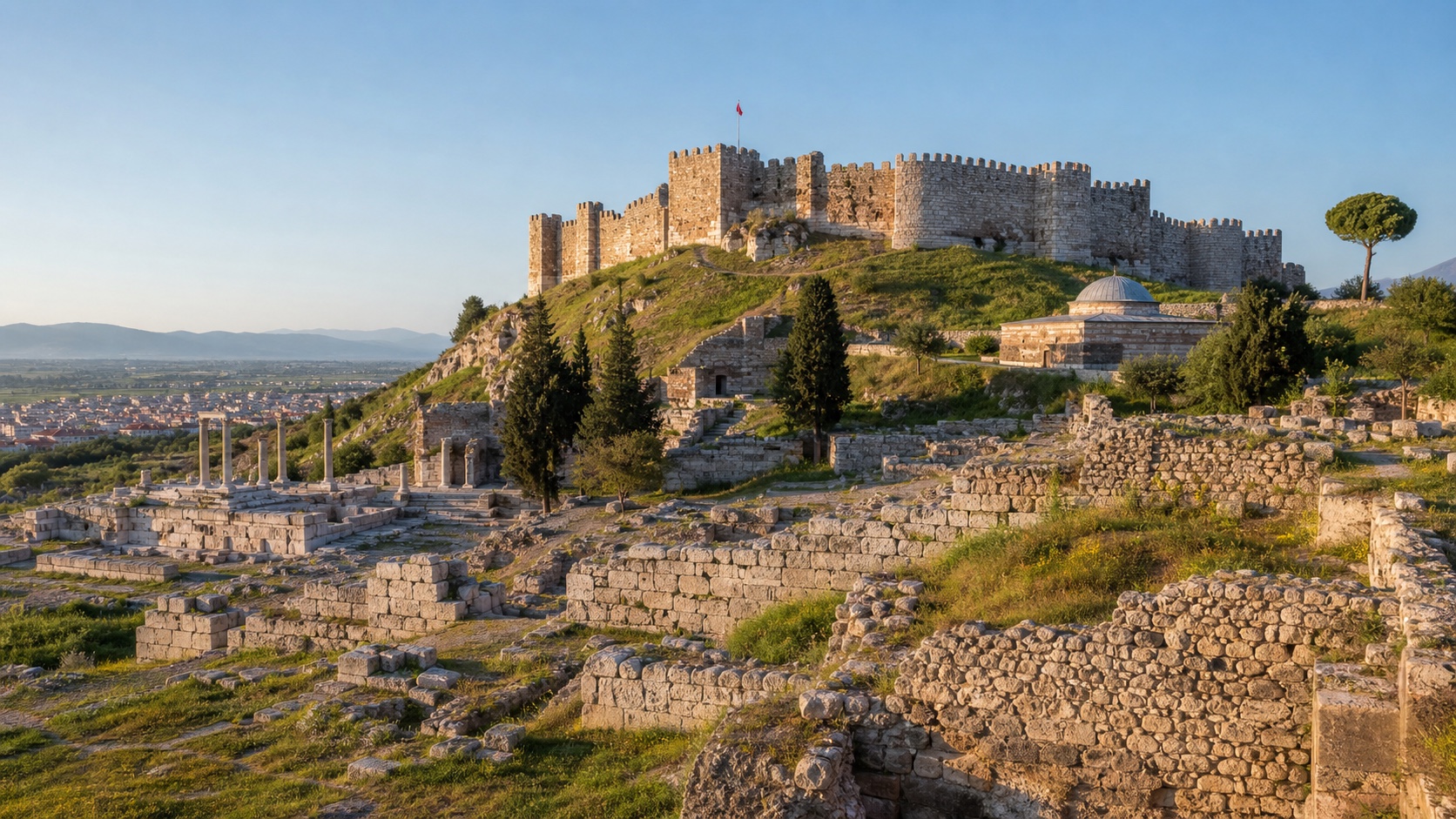
Ayasuluk Hill is where the story of Ephesus continues after the classical city’s harbour declined and settlement shifted. Rising above modern Selçuk, the hill brings together the Basilica of St John, defensive walls, cisterns, a medieval mosque and the castle at the summit.
The location had significance long before the Middle Ages, but it became especially important as a Christian pilgrimage centre. In the sixth century, Emperor Justinian and Empress Theodora sponsored a great domed basilica over the traditional burial place of St John. Later fortification and Turkish-period building transformed the hill again.
From pilgrimage centre to fortified town
As population concentrated around Ayasuluk, walls protected the basilica and settlement. The city was captured by Turkish forces in the early fourteenth century and became an important centre of the Aydınoğulları principality. Cisterns, bath remains, residential traces and sacred buildings show that this was a lived town, not only a castle.
What to see
Basilica of St John
The cruciform basilica deserves separate time. Follow the reconstructed plan, baptistery and central area associated with the saint’s tomb, while distinguishing religious tradition from archaeological proof.
Castle walls and summit
The visible inner walls contain Byzantine, Aydınoğlu and Ottoman phases. From the summit, the relationship between Artemision, Selçuk plain and former coast becomes clear.
Cisterns and Kale Mosque
Water storage was essential on the hill. Several cisterns and a single-domed mosque reveal the practical and religious life of the medieval settlement.
Planning the climb
Access to the upper castle can vary with conservation work. Check current arrangements before visiting and allow at least ninety minutes for the hill and basilica. Paths are steep in places and the summit is exposed to sun and wind.
Do not attempt to combine every Selçuk monument in a short morning. Ayasuluk works best with the Basilica of St John and İsa Bey Mosque; the main Ephesus ruins need their own substantial time.
İzmirBlog can arrange a layered Selçuk day with transport and guiding, linking pagan, Christian and Islamic heritage carefully without suggesting that one tradition can be explained as a simple replacement of another.
Editorial sources: Primary source · Supporting source 1. Visitor information can change; verify current access arrangements before travelling.
Share a useful local note